Sudoku Puzzles
I have been trying my hand at writing sudoku puzzles. Please try my puzzles and give me feedback!
Photocopied
This is now Part 2 of a series that you can view in its entirety here!
You have been gifted a large collection of puzzles from a friend. You sift through them looking for interesting ones and find a photocopy of a puzzle from an old book of puzzles, filed under "puzzles with no given digits". The original book is nowhere to be found and the photocopy is in black and white.
To make matters worse, in box 3, a coffee stain has covered 3 cells. You suspect there may have been clues under the stain, but you can't make them out. At least you can make out that there are no lines connecting any of those cells to any of the adjacent uncovered cells (e.g. there is no line connecting R1C8 to R1C7).
You can see the photocopy here (actually this is outdated for an older version of the puzzle, but you get the idea):
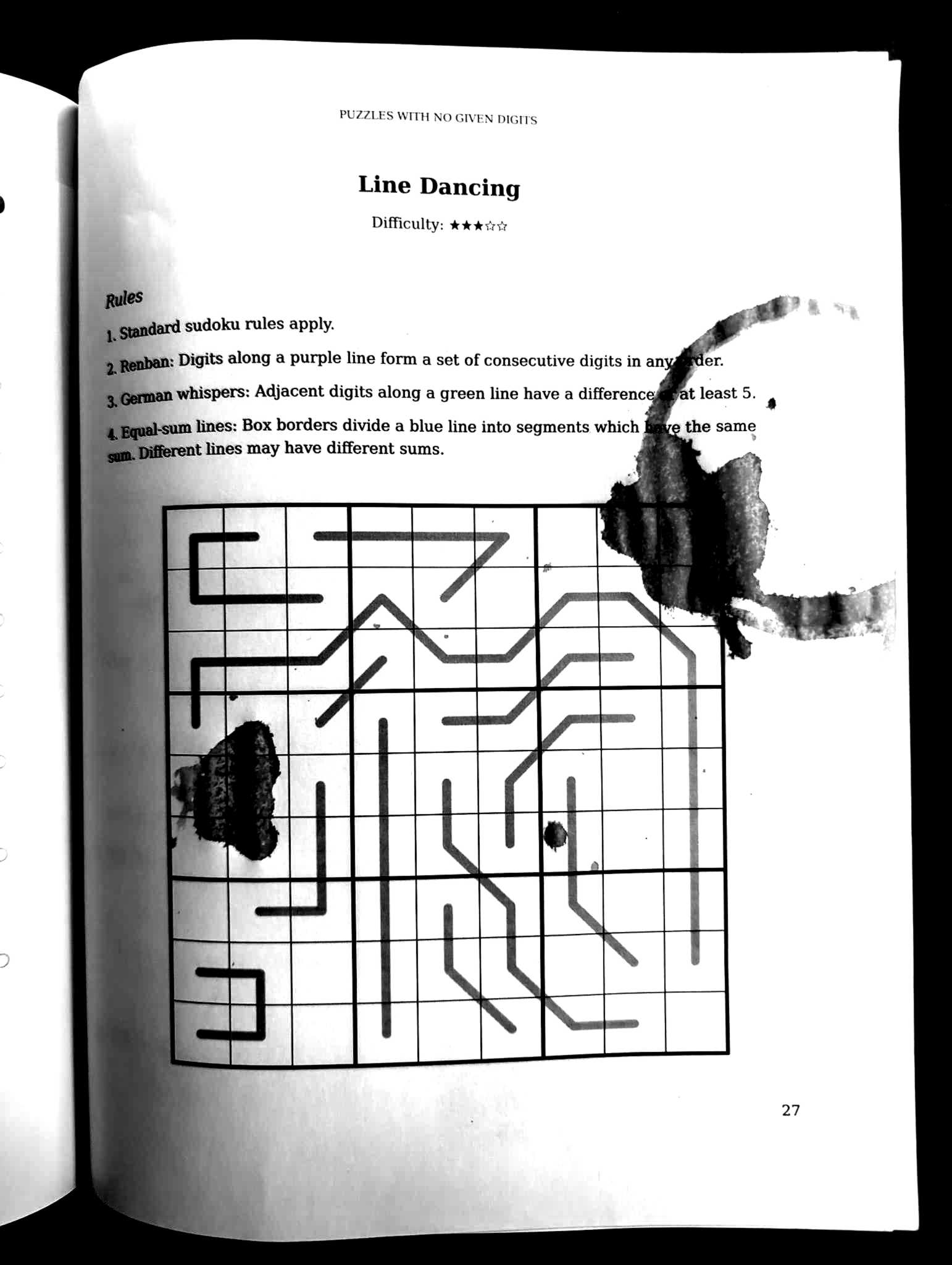
Still, you think it might be solvable regardless. The rules listed for the puzzle are:
Rules:
- Normal sudoku rules still apply.
- Renban: Digits along a purple line form a set of consecutive digits in any order.
- German whispers: Adjacent digits along a green line have a difference of at least 5.
- Equal-sum lines: Box borders divide a blue line into multiple segments which have the same sum. Different lines may have different sums.
What is the original solution to this puzzle?
I have transcribed the puzzle so that it is easier to play:
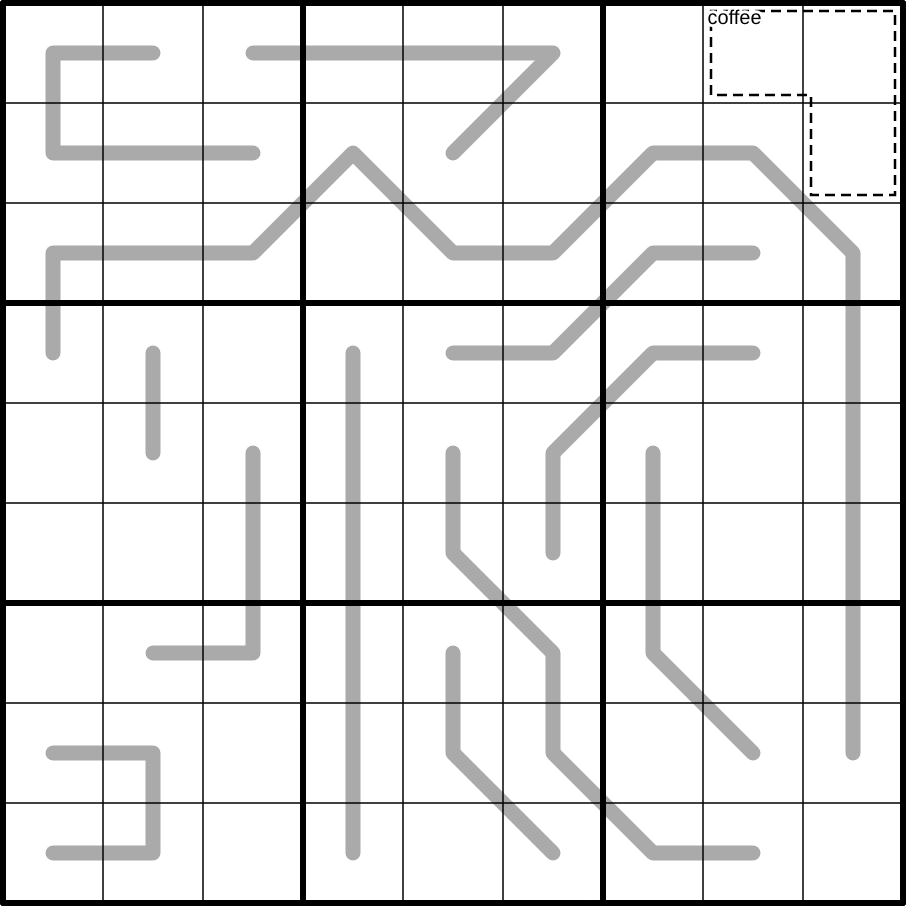
And finally, you can play it online here!
Parity Party
Play the puzzle online here!
Rules:
- Normal sudoku rules still apply.
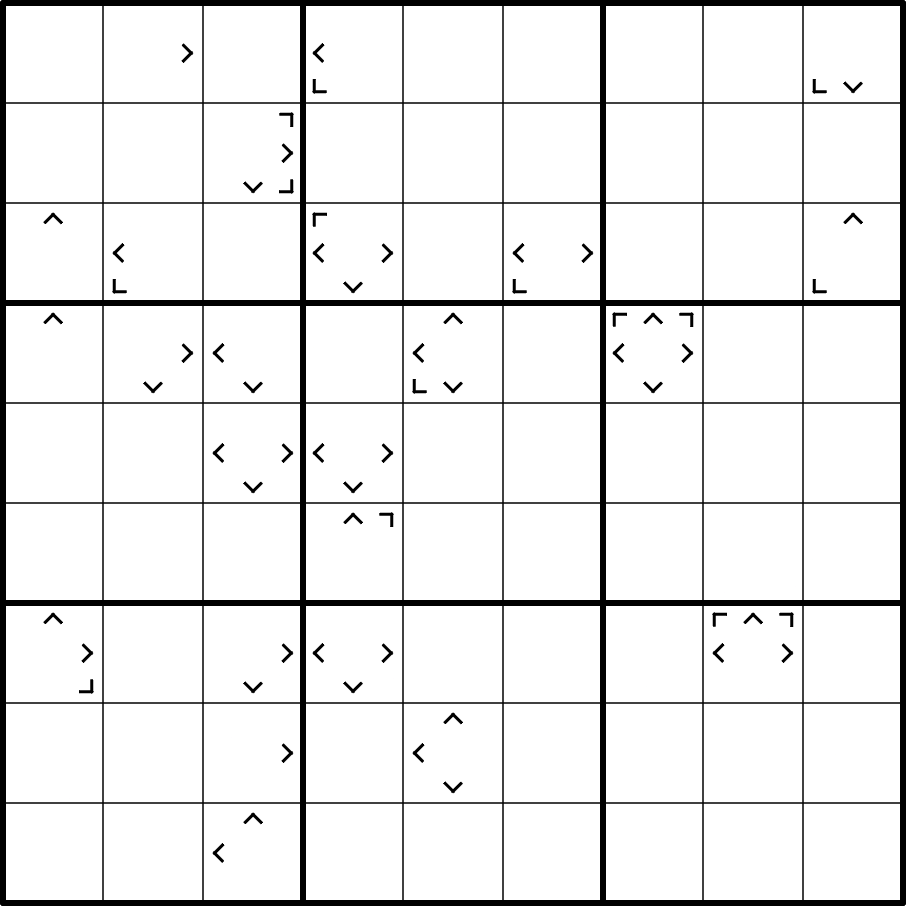
- For each cell with arrows, the number in that cell is equal to either the total number of odd digits or even digits along the rows, columns, and diagonals pointed to by the arrows.
The Puzzle:
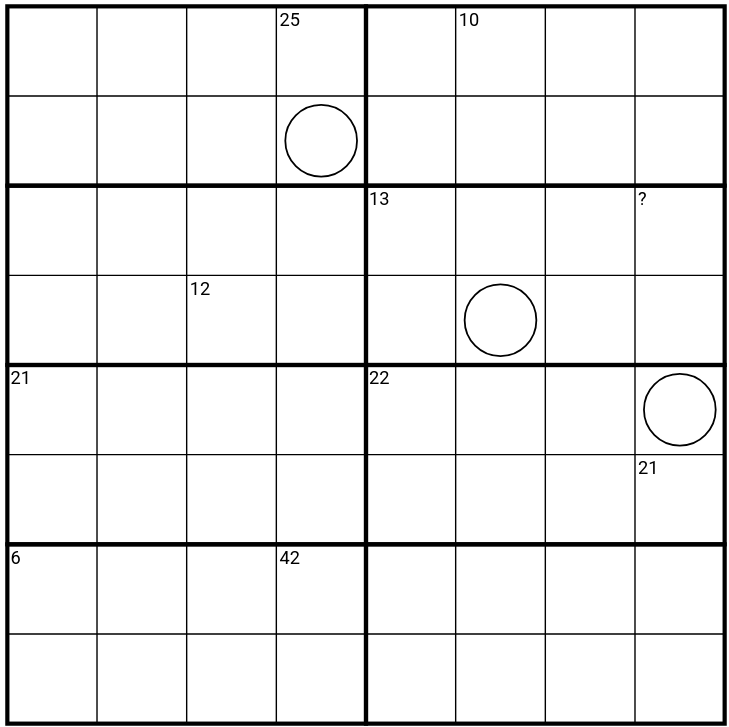
Archipelago
Play the puzzle online here!
Rules:
- Normal sudoku rules still apply.
- Color each square as either 'land' or 'water'
- Each contiguous orthogonally connected set of land cells forms an 'island'
- Similarly, each contiguous orthogonally connected set of water tiles forms a 'lake'
- The largest digit in each island is equal to the total number of cells in that island
- The smallest digit in each lake is equal to the total number of cells in that lake
- The leftmost cell of the uppermost row of each island or lake may contain a number corresponding to the sum of the digits in that island or lake. Note that not all lakes or islands necessarily have their sum displayed. The question mark indicates that that square is the top leftmost square of an island or lake, but no sum is given.
- A circled cell indicates that its digit is equal to the total number of land squares in its 2x4 region.
The Puzzle:
"Rainbow Rain"
Play the puzzle online here!
This is basically version 2 of my first puzzle, "Rain and Broken Mirrors". The break-in logic is identical, but now the remainder of the solve is harder (though it's basically a hard normal sudoku). The ruleset is also much cleaner and the puzzle is more aesthetic.
Rules:
- Normal sudoku rules still apply.
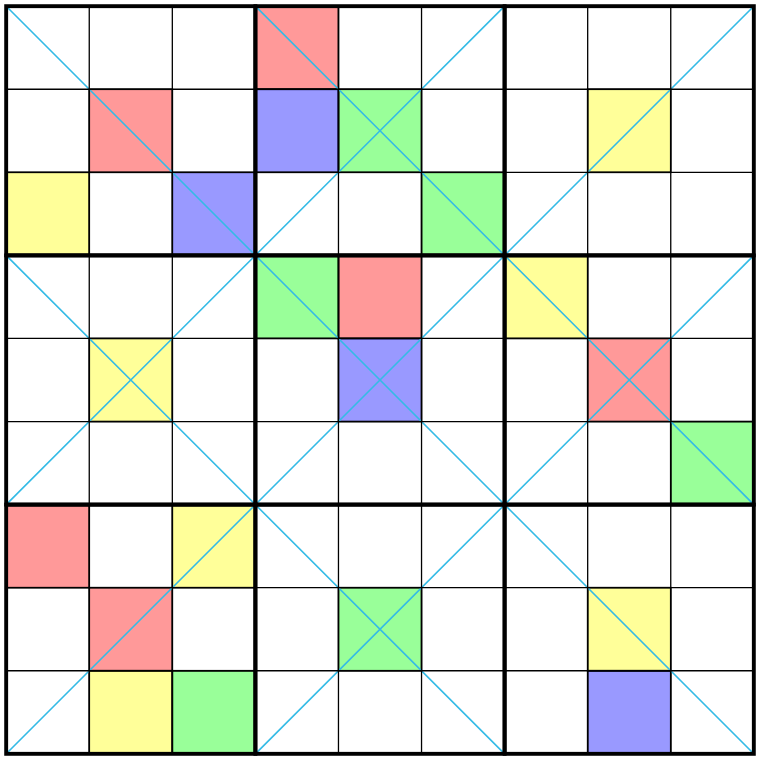
- Digits within a particular color must be in descending order from the top of the puzzle to the bottom.
- Digits must not repeat on any of the 6 marked diagonals.
The Puzzle:
"Mistyped"
Play the puzzle online here!
Rules:
- Normal sudoku rules still apply.
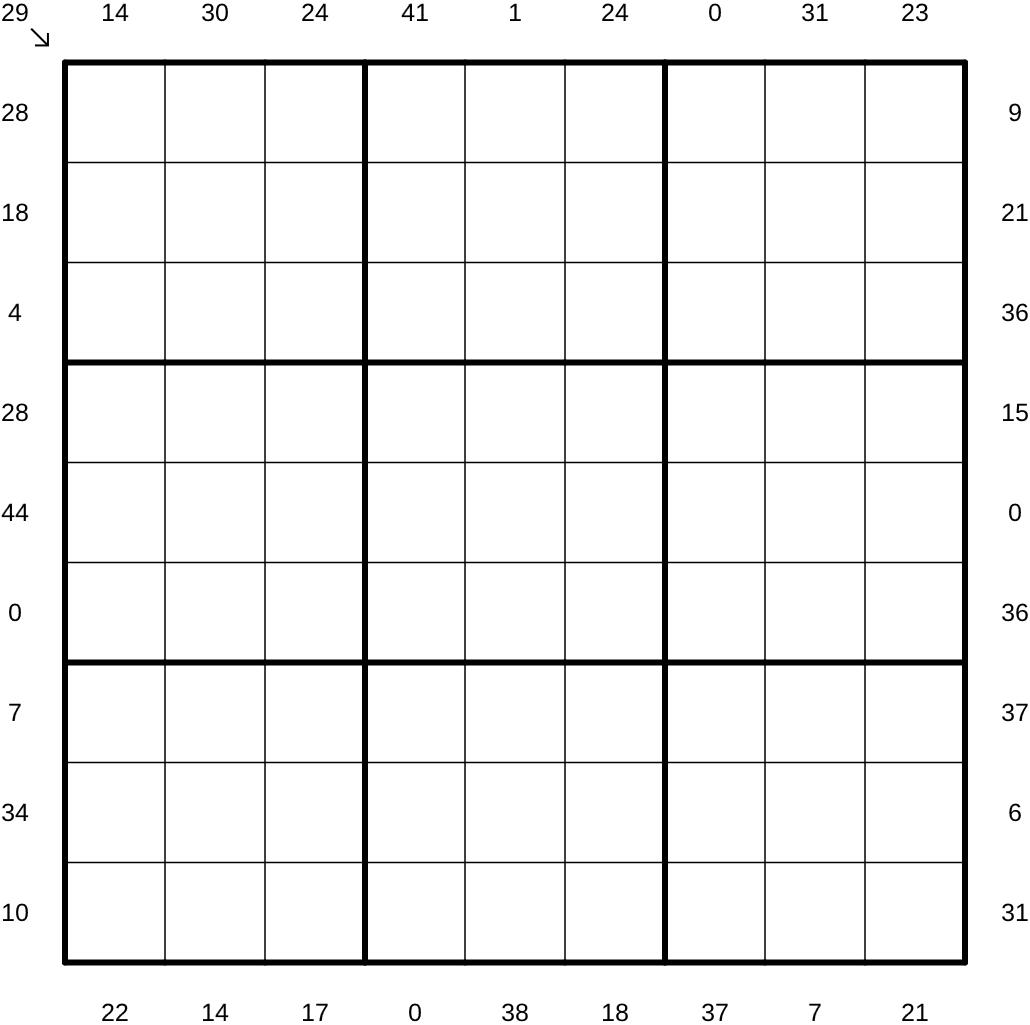
- Color exactly 9 squares, such that every region, row, and column contains exactly one colored square.
- The numbers next to a row or column indicate the sum of the digits along that row or column, starting from the cell closest to the number, up to but not including the colored square on that row or column.
- The number on the top left indicates the sum of the cells along that diagonal, up to but not including the first colored square in that diagonal, or the entire diagonal if there is no colored square on it.
- However, the setter of this puzzle made some typographical errors, and 4 of the numbers outside the puzzle are incorrect.
The Puzzle:
"Double Bubble"
Play the puzzle online here!
Rules:
- Normal sudoku rules still apply.
- Two digit numbers within tictacs are read as standard base 10 numbers, and are equal to the sum of the digits on the corresponding arrow. The red tictac and corresponding arrow are only red for avoidance of ambiguity, their rules are the same as for the gray tictacs.
- Cells separated by a white dot have a difference of exactly 1.
The Puzzle: